- AI
- Project Management
AI Agents for Project Management: What They Can Run, and What Needs a Person
Short answer: AI agents for project management are AI systems that do project-management work on their own initiative: turning meetings into tickets, keeping boards current, flagging stalled work, and handing ready tasks to coding agents. The good ones propose changes for a person to approve. They handle the upkeep. People keep the priorities and trade-offs.
Most software teams already use AI to write code. Far fewer use it to run the work around the code: the tickets, the board, the follow-ups after every planning call. That’s the job AI agents for project management take on.
Teams usually come to them from one of two directions, and the two are related.
The first group wants an AI that does project management. Someone to file the tickets after the planning call, chase the stalled review, and keep the board honest.
The second group already has agents, usually coding agents like Claude Code, Cursor, or Codex, and is discovering that more agents means more to manage. Ten agents opening PRs is great until nobody can say which of them is working from last week’s plan.
Both groups end up in the same place. Software teams need project management to keep up with the speed agents ship at. And a person can’t do that upkeep by hand anymore.
What is agentic project management?
Agentic project management means AI agents carry out project-management tasks without being asked each time. Instead of waiting for a prompt, the agent notices that something needs doing (a meeting produced action items, a ticket went stale, a spec changed) and proposes the update. A person approves anything that changes official plans.
The difference from a chat assistant is initiative. An assistant answers when you ask “what’s the status of the export project?” An agent notices that the export project’s main ticket hasn’t moved in nine days and tells the owner before anyone has to ask.
That’s the whole appeal. If you’re prompting your AI for every update, you’re still doing the project management. You’ve just added a step.
What AI agents can do for project management today
| Job | Ready today? | What a person still does |
|---|---|---|
| Turn meeting decisions into tickets with owners | Yes | Approve the tickets before they’re filed |
| Draft standups and status updates from real activity | Yes | Add the work that doesn’t show up in Git |
| Flag stalled tickets and aging commitments | Yes | Decide whether to push, reassign, or drop |
| Keep tickets in step with decisions made in Slack | Mostly | Confirm the decision was actually final |
| Break a rough idea into issues | Good first drafts | Check scope and sizing |
| Hand a ready ticket to a coding agent | Yes | Review what the coding agent ships |
| Set priorities and make trade-offs | No | All of it |
The pattern is consistent. Agents are reliable at the clerical half of project management. They’re not ready for the judgment half, and on most teams nobody wants them to be.
Why coding agents make project management harder
Coding agents increase how much work a team ships, which increases how much has to be planned, tracked, and checked. They also act on whatever ticket or spec they’re given. If that ticket is out of date, the agent builds the wrong thing quickly and confidently.
A person reading a stale ticket usually notices. They remember the meeting where the plan changed, or they ask in Slack. A coding agent doesn’t. It does exactly what the ticket says, wrong parts included.
So the job of project management on an agent-heavy team shifts. It’s less about tracking who’s doing what, and more about making sure every person and every agent is working from the same, current version of the plan.
Pointing your agents at Linear or GitHub helps, but it’s not enough on its own. The tracker only knows what someone typed into it. The decision that changed the plan was made in a meeting on Tuesday, and the ticket still says Monday’s version.
The rules that make AI agents safe for project management
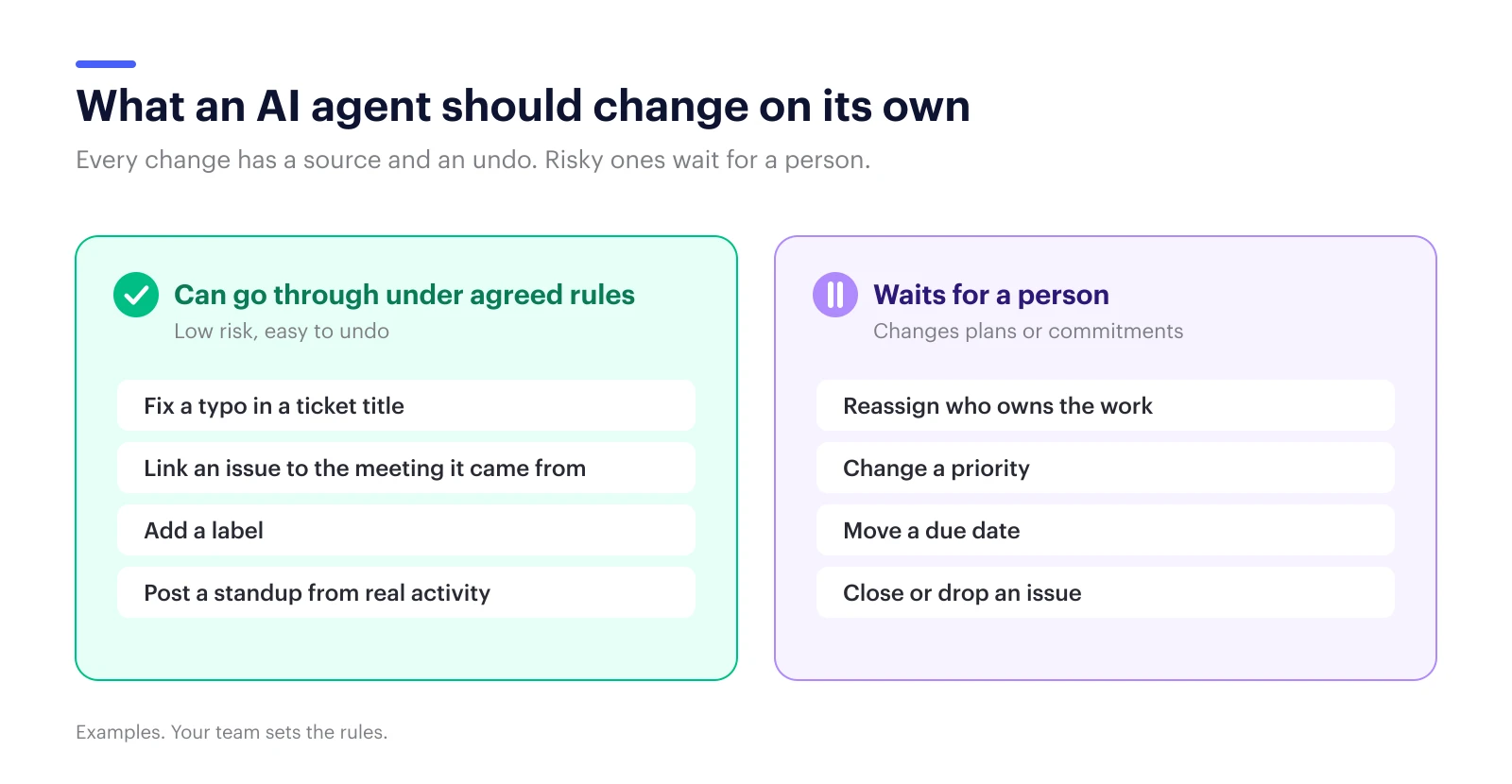
Every change an AI agent makes to your plans should have a source you can check, be easy to undo, and go through a person (or a clear rule) before it becomes official. Small, low-risk updates can go through automatically under agreed rules. Ownership changes, priority changes, and commitments should wait for a person.
These are the questions to ask any AI tool before you let it touch your tracker:
- Can I see where this came from? “Created from Tuesday’s planning call, at 14:32” with a link is trustworthy. A ticket that appears from nowhere isn’t.
- Can I undo it? If the agent overwrote a description, can you see what was there before?
- Who approves what? Fixing a typo in a ticket title is low risk. Reassigning work or changing a due date is not. The rules should say which is which.
- Does it nag? An agent that pings about everything gets muted in a week. One accurate “this needs you” is worth more than twenty updates.
The human-in-the-loop part is easy to get wrong. A person technically reviewing every change isn’t the same as a person controlling anything. The test is simple: could that person say no, and would anything change if they did?
Where Thor fits
Thor is an AI project manager for software teams that run coding agents, from the team behind Zenhub. It doesn’t replace your agents, and it isn’t another one to adopt. It works with the tools and agents your team already chose.
Thor works in GitHub, Linear, Slack, and your meetings. It drafts tickets from meetings, keeps them in step with what was decided, flags stalled work, and can hand a ready ticket to Claude Code or Cursor. Every change is a proposal with a source and an undo. And through Thor’s MCP server and CLI, your coding agents read the same up-to-date picture of the work that your team sees, so they stop guessing from stale tickets.
FAQ
What is the best AI agent for project management?
It depends on where your plans live. If everything is in one tracker, that tracker’s built-in AI (Linear Agents, Atlassian Rovo, ClickUp Brain) is a reasonable start. If decisions happen across GitHub, Linear, Slack, and meetings, and your team runs coding agents, you need something that keeps all of those in step, like Thor.
Can AI agents replace a project manager?
No. AI agents can take over project-management upkeep: tickets, status updates, follow-ups. Priorities, trade-offs, and commitments to people still need someone accountable. On teams with agents, that judgment matters more, because a wrong plan gets built much faster.
How do AI agents work with Jira or Linear?
Most connect through the tracker’s API or an MCP server and can read and update issues. The safer ones propose changes for a person to approve instead of writing directly, and they show where each change came from.
Is agentic project management safe?
It’s safe when every change has a source, can be undone, and goes through a person or a clear rule before it’s official. It’s risky when an agent can silently change plans because a model sounded confident.
If your team ships faster than anyone can keep the plan straight, Thor can take the upkeep and keep your agents working from the current plan. It won’t change anything without asking first.