- AI
- Project Management
Will AI Replace Project Managers? What It Takes Over, and What It Can't

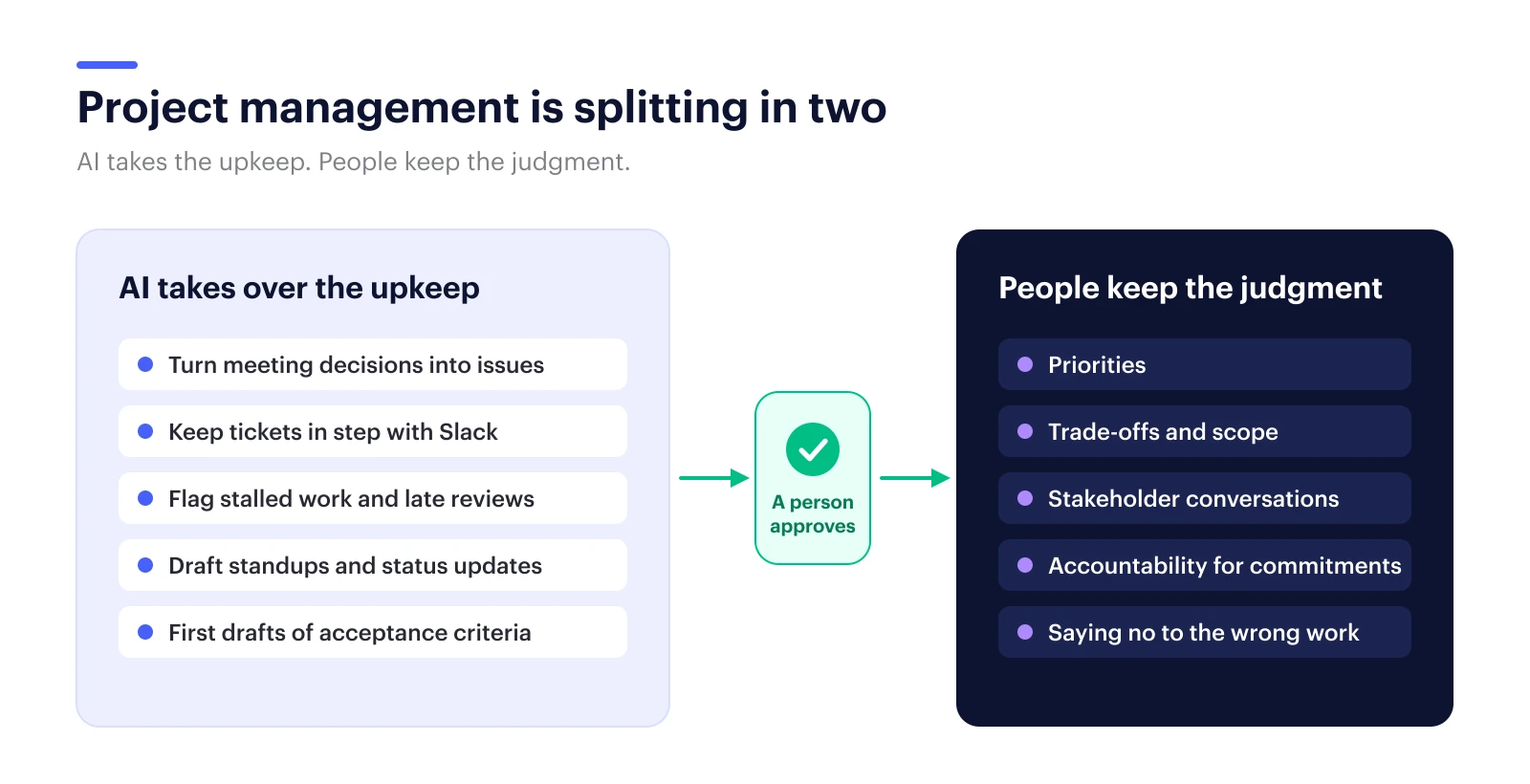
Short answer: No. AI is taking over the upkeep part of project management: turning meeting notes into tickets, keeping boards current, chasing stalled work, and drafting status updates. It isn’t taking over the judgment: deciding priorities, making trade-offs, and owning commitments with people. On software teams, the project manager’s job shifts from updating the board to approving what an AI project manager proposes.
Most answers to this question are either doom (“PMs are finished”) or comfort (“AI is just a tool”). Neither matches what we see on software teams.
What we actually see is a job splitting in two. One half is upkeep: re-typing decisions into tickets, chasing reviews, writing the Friday update. That half is going away, and honestly, few project managers will miss it. The other half is judgment: what to build, what to cut, when to say no. That half is getting harder, because teams now ship more work, faster, with coding agents in the mix.
So it’s less a replacement than a change in where a PM’s hours go.
What AI already does well in project management
AI is reliable today at the routine, high-volume parts of project management: drafting issues from meeting decisions, keeping tickets in step with what was said in Slack, flagging stalled work, writing first drafts of acceptance criteria, and assembling status updates from real activity.
Task by task, on a typical software team:
| Project management task | Can AI do it today? | What the PM still does |
|---|---|---|
| Turn meeting decisions into issues with owners | Yes | Approve the issues before they’re filed |
| Keep tickets in step with decisions made in Slack | Mostly | Confirm the decision was final |
| Flag stalled work and overdue reviews | Yes | Decide whether to push, reassign, or drop |
| Draft standups and status updates | Yes | Add context the tools can’t see |
| First drafts of acceptance criteria and sub-tasks | Yes | Check scope and edge cases |
| Suggest labels and organize the backlog | Yes | Set the order that matters |
| Prioritize the roadmap | No | All of it |
| Negotiate scope with stakeholders | No | All of it |
Developers want this too. In a Zenhub survey of developers, 71% said they were actively exploring AI tools for their work, and “planning, estimation, and prioritization” topped the list of project-management jobs they’d most like AI to improve or take over. Their biggest worries were data accuracy, security, and privacy. (Full survey results.) [Verify: add the survey year and number of respondents.]
The first six rows used to fill a lot of a PM’s week. They’re also the parts most likely to slip when that PM gets busy, which is why teams feel the gap so quickly when nobody’s doing them.
What still needs a person
AI can’t decide what matters most, make trade-offs between goals, negotiate with stakeholders, or be accountable for a commitment. It also can’t see context that never reaches a tool, like a promise made to a customer on a call nobody recorded.
- Priorities. AI can sort by labels and due dates. It doesn’t know which customer the CEO promised the fix to.
- Trade-offs. Cutting scope to hit a date means disappointing someone. A person has to own that.
- Stakeholders. Telling a VP that their feature slips a quarter is a conversation, not an update.
- Accountability. When a commitment is missed, someone has to answer for it and fix the plan.
- Saying no. The most valuable thing a PM does on an agent-heavy team is stop the wrong work before it starts. AI tends to agree with whatever it’s given.
That last one matters more every month. When coding agents can build a feature in an afternoon, a vague or wrong plan doesn’t cost you a few days anymore. It costs you a pile of confident, wrong work.
What changes for project managers, engineering managers, and scrum masters
The job shifts from doing upkeep to reviewing it. Instead of updating the board, a PM approves what an AI project manager proposes, spends more time on priorities and stakeholder calls, and focuses on keeping the plan right before work starts.
For project managers, the week tilts toward decisions. Less time copying meeting notes into GitHub. More time on planning conversations, scope calls, and checking that the plan matches what customers need.
For engineering managers, who often absorbed project management off the side of their desk, it’s time back. The “human router” part of the job (who’s doing what, what’s blocked, what did we decide) is exactly what AI handles well.
For scrum masters, the ceremonies stay, but the prep goes. That’s the next question.
Can an AI be your scrum master?
An AI can take over a scrum master’s admin: preparing standups from real activity, tracking sprint progress, flagging blockers, and drafting sprint reviews and retro notes. It can’t coach a team, resolve conflict, or protect the team from scope creep. Those need a person.
AI is a decent scrum master’s assistant. It can post the standup from what actually moved yesterday, spot that a ticket has been blocked for three days, and pull together a sprint review in minutes. Zenhub’s AI Sprint Review does that last one directly in Zenhub. [Verify: confirm current feature name and behavior.]
What AI can’t do is the human half of the role. Noticing that two engineers have stopped talking to each other. Pushing back on a stakeholder who keeps adding scope mid-sprint. Helping a team get better at estimating instead of just recording their misses. That’s coaching, and it stays with people. We asked three agile coaches about this directly in will AI take over agile coaching?
For more on running the ceremonies themselves, see our guide to better sprint retrospectives.
Why approval matters
When AI does project-management upkeep, every change should have a visible source, be easy to undo, and go through a person before it becomes official. Without that, a model’s confident mistake becomes the team’s plan, and nobody notices until something ships wrong.
This is where the “replace” framing gets it backwards. The more AI does, the more a person’s approval is worth. A PM who reviews ten proposed updates a day, each with a source (“from Tuesday’s planning call”) and an undo, has more control than one who manually updated three tickets and missed seven.
It’s the model we built Thor around. Thor is an AI project manager for software teams, from the team behind Zenhub. It drafts issues from meetings, keeps GitHub and Linear tickets in step with what was decided in Slack, follows up on stalled work, and checks a plan against what your team has already decided before anyone builds it. It proposes. A person approves.
FAQ
Which project management jobs are most affected by AI?
Roles that are mostly coordination upkeep (status reporting, ticket hygiene, meeting follow-up) change the most. Roles built around judgment, like product management, program management, and engineering leadership, change less, and the judgment parts become a bigger share of the job.
What should project managers learn now?
Get good at reviewing AI work quickly: spotting a wrong assumption in a drafted ticket, checking sources, and setting rules for what AI can change without asking. Also lean harder into the parts AI can’t do: prioritization, stakeholder conversations, and writing clear plans that agents can build from.
Will AI replace scrum masters?
No. AI can take over scrum admin like standup prep, sprint tracking, and review drafts. Coaching the team, resolving conflict, and protecting the sprint from scope creep still need a person.
Is project management a safe career with AI?
The upkeep part of the role is shrinking. The judgment part is growing, especially on teams running coding agents, where a wrong plan gets built much faster. Project managers who focus on decisions and on reviewing AI output are in a stronger position, not a weaker one.
If your week goes to upkeep instead of decisions, Thor can take the upkeep. It won’t change anything without asking first.