- AI
- Project Management
AI Project Management for Software Teams: What It Does and Where It Stops

Short answer: AI project management means using AI to do the upkeep of running software projects: turning meeting decisions into issues, keeping tickets and boards current, catching stalled work, and drafting status updates. An AI project manager does that work inside the tools your team already uses and asks a person to approve changes. People still own priorities and trade-offs.
Shipping got fast. Keeping track of what shipped didn’t.
Coding agents open PRs faster than anyone can review them. A planning call changes the plan, and the ticket still says last week’s version. Somebody spends Thursday afternoon re-reading Slack threads to figure out what the team actually agreed to. Usually that somebody is an engineering manager, a tech lead, or the one PM covering three teams.
That gap is what AI project management is for. Not a smarter Gantt chart. A way to keep the plan true to what’s happening without a person doing it by hand.
What is AI project management?
AI project management is the use of AI to handle the coordination side of running a project: capturing decisions, creating and updating tasks, keeping boards and roadmaps current, flagging risk, and summarizing progress. For software teams, it works on top of GitHub, Linear, Slack, and meetings rather than replacing them.
The definition gets stretched until it covers anything with a chat box. Two questions cut through it:
- Does it do work a person would otherwise do by hand? Summarizing a ticket you were going to read anyway doesn’t count. Filing the five issues that came out of a planning call does.
- Can you see what it did, and undo it? If an AI tool edits your board because a model sounded confident, you’ll catch it being wrong once. After that, nobody trusts the board.
If a tool passes both, it’s doing project management. If not, it’s autocomplete with a nicer interface.
We’ve written a separate guide on AI in agile project management for teams working in sprints. This post is about the day-to-day upkeep on any software team.
What does an AI project manager do?
An AI project manager does the routine work a project manager does: it organizes the backlog, creates and updates issues from meetings and Slack, keeps boards current, follows up on stalled work, and keeps the roadmap in step with what’s actually shipping. It proposes each change for a person to approve.
Here’s what that looks like in a normal week:
| When | What happens without AI | What an AI project manager does |
|---|---|---|
| After the Monday planning call | Someone re-types decisions into GitHub or Linear, if they remember | Drafts the issues, with owners and a link to the moment in the call. You approve them |
| A plan changes in a Slack thread | The ticket keeps the old plan until someone notices | Proposes the ticket update, with the thread as the source |
| A PR has waited three days for review | Nobody notices until the release slips | Pings the reviewer once, with why it matters |
| An issue sits “In Progress” for three weeks | It looks exactly like one updated an hour ago | Flags it to the owner |
| Friday status update | Someone spends an hour assembling it | Drafts it from what actually moved |
None of these are hard. They’re just constant. On most teams this upkeep is somebody’s unofficial second job, and it’s the first thing that slips when that person gets busy.
What AI project management can’t do (yet)
AI is reliable at the clerical half of project management and weak at the judgment half. It can’t decide what matters most, make trade-offs between competing goals, or own commitments to people. It also can’t capture work that never shows up in a tool, like a design discussion over coffee.
Be honest with yourself about this split before you buy anything:
- Prioritization. AI can sort by labels and due dates. It doesn’t know that the CEO promised a customer the export fix by Friday.
- Trade-offs. Cutting scope to hit a date is a judgment call with people attached to it.
- Quiet work. Pairing, design reviews, and unblocking a teammate don’t leave much of a trail in Git.
- Being right about intent. A transcript captures what was said, not always what was meant. That’s why approval matters.
A good AI project manager is built around this. It drafts and proposes, and a person decides.
How AI project management works on a software team
An AI project manager connects to the places where work is discussed (Slack, Teams, meetings) and the places where it’s tracked (GitHub, Linear). It keeps one up-to-date picture of what’s been decided and what’s stale, then proposes updates to your tracker with a source for each one. Coding agents can read that same picture.
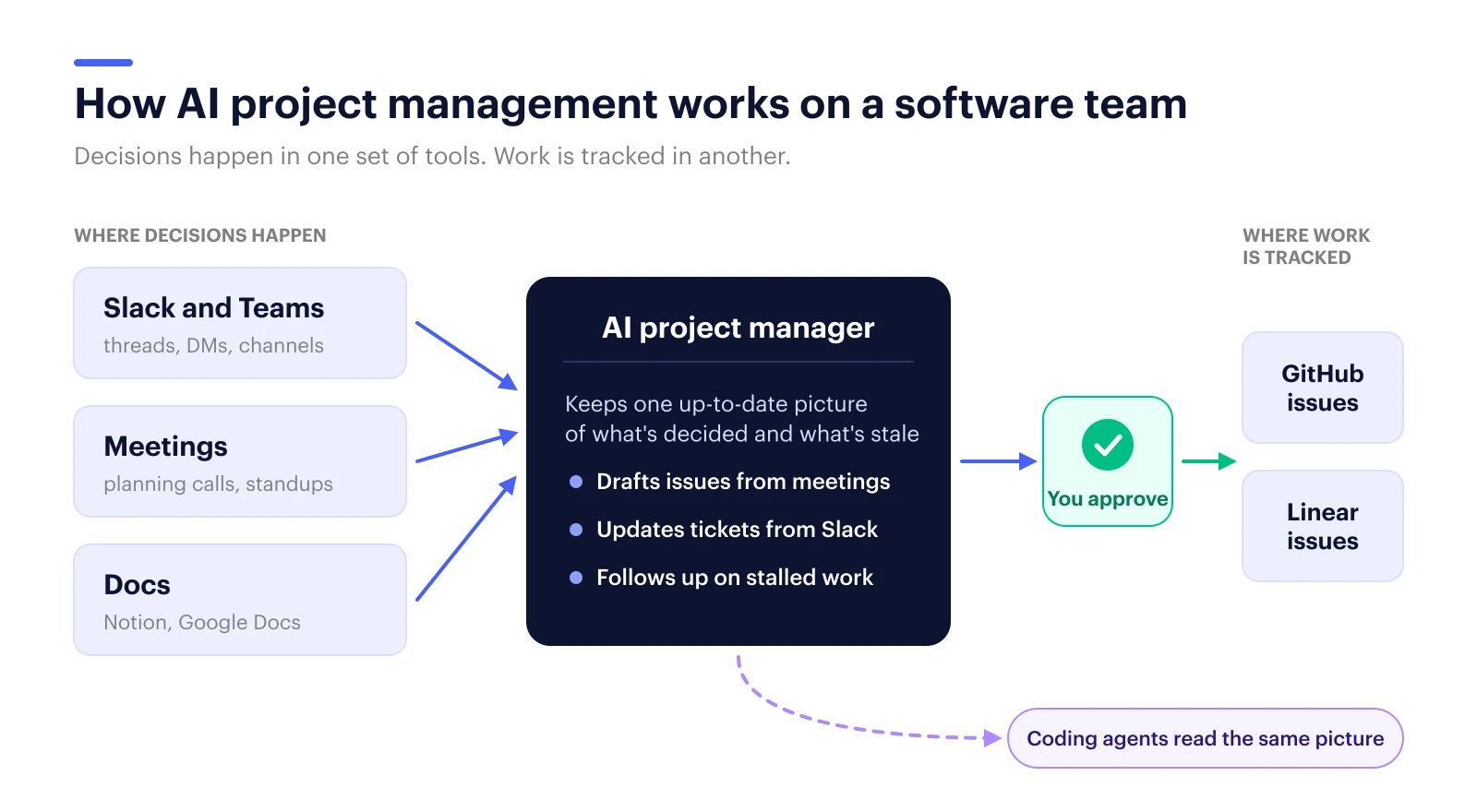
Three pieces matter:
It comes to the work. It reads the Slack threads, meeting transcripts, and issues that already exist. Nobody has to log anything new or open another app every morning.
It keeps one current picture. Every AI feature inside a single tool sees one slice. Your tracker’s AI sees the tracker. Your note-taker sees the meeting. The real story of a project is spread across all of them, so something has to keep them in step.
It asks first. Each change is a proposal with a source (“from Tuesday’s planning call, 14:32”) and an undo. Small, low-risk updates can go through under rules you set. Ownership changes and priority changes wait for a person.
This is also why AI project management matters more on teams running coding agents. An agent working from a stale ticket does exactly what the ticket says, wrong parts included. A current plan is what keeps agents building the right thing.
Zenhub and Thor
We build two products for this, and they do different jobs.
Zenhub is where you plan and track work in GitHub: boards, sprints, roadmaps, and reporting next to the code. Zenhub AI helps inside that plan, with suggested labels, AI-written acceptance criteria, and AI Sprint Reviews.
Thor keeps the plan true to what’s happening. Thor is an AI project manager for software teams, from the team behind Zenhub. It works in GitHub, Linear, Slack, Teams, and your meetings. It drafts issues from meetings, keeps tickets in step with decisions made in Slack, follows up on stalled work, and posts standups from real activity. You approve what it proposes, and every change has a source and an undo. Your coding agents can read the same picture through Thor’s MCP server.
How to start with AI project management
Start with the coordination task that costs the most time each week, not the most impressive demo. Pick a tool that works in your existing tracker, proposes changes for approval, and shows a source for each one. Measure one boring number for two weeks, then keep it or drop it.
- List the upkeep you do in a normal week. Be literal: “Re-typed planning call decisions into GitHub: 40 minutes.”
- Pick the worst item. Meeting-to-issue is a common first win because it’s frequent and easy to check.
- Insist on approval and sources. Anything that writes to your tracker silently will eventually be wrong.
- Measure something boring. Time from decision to issue. Action items dropped. How often someone asks “what’s the status of X?”
- Decide after two weeks. If the team needs reminding to use it, it won’t last.
If you’re comparing options, our roundup of the best AI project management tools for software teams sorts them by the job each one does.
FAQ
What is an AI project manager?
An AI project manager is AI that does a project manager’s routine work: organizing the backlog, creating and updating issues, keeping boards current, and following up on stalled work. On software teams it works inside GitHub, Linear, Slack, and meetings, and proposes changes for a person to approve.
Is AI project management worth it for small teams?
It pays off once coordination becomes someone’s job, usually around ten or more people with a real tracker, chat tool, and regular meetings. Below that, the upkeep is small enough that a person can do it in a few minutes a day.
Will AI replace project managers?
No. AI is taking over the upkeep: issues, status updates, follow-ups. Priorities, trade-offs, and commitments to people still need someone accountable. We cover this in more depth in will AI replace project managers?
Does AI project management work with GitHub?
Yes. Zenhub plans and tracks work directly in GitHub, and Thor drafts and updates GitHub issues (and Linear issues) from meetings and Slack, with a person approving each change.
If your team ships faster than anyone can keep the plan straight, Thor can take the upkeep off your plate. It won’t change anything without asking first.